
BiForm vs Timber
Which should you choose?
Timber or composite? It’s the question we get asked most.
Nobody ever fell in love with a deck because of its maintenance schedule. Timber is beautiful — that’s never been in question. But it’s a borrowed beauty. It wants oiling, staining and sanding to hold its colour, and the season you skip is the season it starts going grey.
BiForm composite decking was built to give you both. The warmth and grain of real timber — it is 60% timber fibre, after all — without the rot, the splinters, the annual recoat or the fade. It won’t warp or swell, it carries an R11 slip rating and a 25-year warranty, and the upkeep is a wash down.
On a standard 6.0 × 4.2m deck, BiForm works out $1,327 cheaper than Kwila and $2,368 cheaper than Vitex once you add up fifteen years of buying, laying and looking after it. Here is the full comparison, with the test data behind every claim, so you can check it yourself.
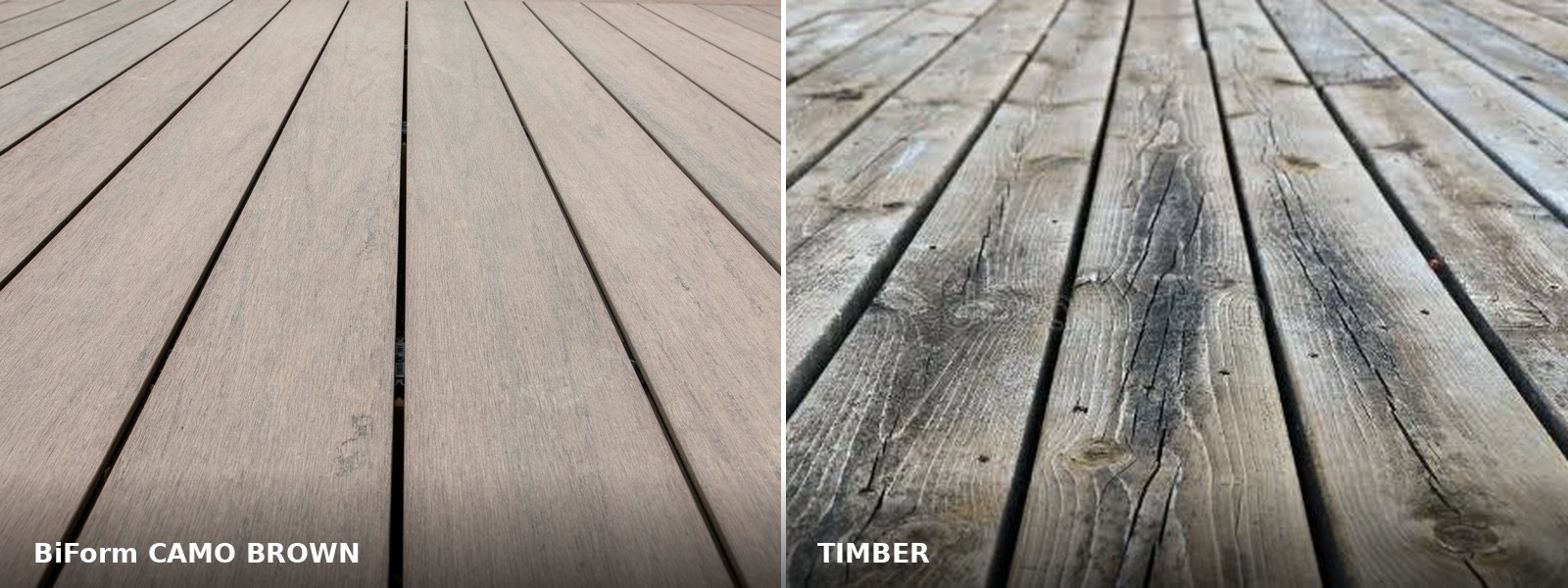
How BiForm compares to timber
Feature | BiForm Composite Decking | Timber | Source |
|---|---|---|---|
Durability | ✅ Will not rot, warp or twist | ❌ Susceptible to rot and insect attack; relies on treatment and upkeep | BRANZ Appraisal No. 680 (2025) |
Moisture Resistance | ✅ Does not swell or move with moisture | ❌ Absorbs moisture and swells, leading to warping, twisting and cracking | — |
Antifungal | ✅ Manufactured with an anti-fungal additive | ❌ Prone to mould and mildew in shaded, damp areas | BRANZ Appraisal No. 680 (2025), cl. 10.2 |
UV Resistance | ✅ Accelerated weathering tested to ASTM G155. At 30% plastic content it moves less under NZ UV than composites built at 50% | ❌ Fades, greys and degrades without regular recoating | BRANZ Appraisal No. 680 (2025), cl. 17.1 |
Longevity | ✅ Serviceable life in excess of 15 years per BRANZ, backed by a 25-year limited warranty | ❌ Varies with timber grade, treatment and upkeep | BRANZ Appraisal No. 680 (2025), cl. 9.1 |
Slip Resistance | ✅ R11 on both the grooved and smooth faces | ❌ Varies; smooth and wet timber can be slippery | BRANZ Appraisal No. 680 (2025), cl. 13.1 — CSIRO, AS 4586 |
Splinters | ✅ Solid through the board, no splinters | ❌ Splinters as it weathers | — |
Fire Rating | ✅ Critical radiant flux 5.7 kW/m², tested to ISO 9239-1 — exceeds the NZBC minimum | ❌ Treated pine is combustible and not typically fire rated | BRANZ Appraisal No. 680 (2025), cl. 12.1 |
Building Code | BRANZ Appraised. Covers B1 Structure, B2 Durability and F2 Hazardous Building Materials | Covered by NZS 3604 and the timber treatment standards | BRANZ Appraisal No. 680 (2025), cl. 3.1 |
Installation | ✅ One day on a 25.2m² deck. Hidden clips, no sorting, pre-drilling or countersinking | ❌ Two days for the same deck. Boards sorted and straightened, screws pre-drilled and countersunk | Builder feedback |
Fixings | ✅ Hidden clip system, no visible screws | ❌ Face-fixed screws, visible and prone to lifting | — |
Low Maintenance | ✅ Wash down. No oiling, staining or painting | ❌ Oil or stain every 1–2 years for the life of the deck | BRANZ Appraisal No. 680 (2025), cl. 10.1 |
Cost-Effectiveness | ✅ $5,994 over 15 years on a 25.2m² deck | ❌ $7,321 Kwila, $8,362 Vitex over the same period | BiForm cost comparison, Sept 2026 |
Sustainability | ✅ 60% FSC®-Certified Timber and 30% recycled HDPE | ❌ Virgin or plantation timber, chemically treated | FSC® Chain of Custody FSC-C205826 |
Toxic Chemicals | ✅ Red List Free, with a Declare label to prove it | ❌ Carries preservative chemicals from H3.2 and higher treatments | BiForm Declare label |
Aesthetic Variety | ✅ Six colours, coloured through the board | ❌ Limited to natural timber tones | BRANZ Appraisal No. 680 (2025), cl. 4.3 |
Warranty | ✅ 25-year limited warranty | ❌ Typically shorter periods, or no warranty at all | BiForm warranty document |
What it costs over the life of the deck
Take a standard 6.0 × 4.2m deck — 25.2m². Here is what it costs to buy, lay and look after for fifteen years, against the two timbers most often specified in its place.
BiForm | Kwila | Vitex | |
|---|---|---|---|
Up front, installed | $5,394 | $5,071 | $6,112 |
Time on site | 1 day | 2 days | 2 days |
Upkeep per year | $40 — cleaning only | $150 — clean, oil and stain | $150 — clean, oil and stain |
What you pay over 15 years | $5,994 | $7,321 | $8,362 |
Warranty | 25 years | None | None |
What that means for you. Against Vitex you are better off from the day it is laid — it costs less to install and less to keep. Against Kwila you pay $323 more up front, but $110 less every year, so you are ahead after two years and eleven months, and further ahead every year after that.
Over fifteen years that is $1,327 back in your pocket against Kwila, and $2,368 against Vitex — before you count the weekends you would have spent sanding and oiling.
Based on September 2026 trade pricing, two installers at $70/hr, and the same subfloor and joist centres for all three. Excludes subfloor, freight and GST. Upkeep is materials only and excludes your own time: for BiForm that is cleaning, and for the timbers it is cleaning plus oiling or staining. Prices move — treat these as indicative and ask your builder to price your deck.


Common questions about composite decking
Is composite decking better than timber?
For durability and maintenance, yes. Composite will not rot, warp or splinter, needs no oiling or staining, and BiForm carries a 25-year limited warranty where timber decking usually carries none.
Timber costs less per metre and some people prefer how it weathers. Composite costs more to buy, and dark colours get warmer in direct sun.
Does composite decking rot or get eaten by borer?
No. BiForm will not rot, and it is unaffected by borer and termites. BRANZ Appraisal No. 680 (2025) assesses it against the Building Code for durability.
Timber is susceptible to both, and relies on chemical treatment and ongoing maintenance to resist them.
Does composite decking swell or warp when it gets wet?
No. BiForm does not swell, warp or twist with moisture, so it holds its shape through a wet winter.
Timber absorbs moisture and moves with it. That leads to warping, twisting and cracking, and in time to structural weakness.
Does composite decking fade in the New Zealand sun?
Some colour loss is expected while the boards stabilise over the first few months, and BRANZ notes that some further loss of colour is to be expected over time with exposure to weathering (BRANZ Appraisal No. 680 (2025), cl. 9.1). The boards are UV tested for New Zealand conditions and the colour runs right through the board, so there is nothing to recoat.
BiForm is 30% plastic. Composites built at 50% expand and contract further under the same UV load, which is why we hold the ratio where it is. Timber greys continuously unless it is recoated.
How does BiForm perform in a fire?
BiForm has a critical radiant flux of 5.7 kW/m² for FORM 130 and FORM 140, and 5.4 kW/m² for Forest Board, tested to ISO 9239 Part 1. Both exceed the minimum required by the New Zealand Building Code (BRANZ Appraisal No. 680 (2025), cl. 12.1). As with any decking, it must be separated from heat sources in line with C/AS1 and C/AS2.
It has also been chosen on fire performance. Specifying decking for a public smoking area at Auckland Airport, architects Jasmax compared composite products by setting samples alight on the bench. BiForm was the slowest to burn and the most resistant to the flame, and it was specified. That deck has been in service since 2018 in one of the country’s highest-traffic public spaces.
Is composite decking slippery when wet?
BiForm carries an R11 slip resistance rating on both the grooved and the smooth face, tested by CSIRO to AS 4586 using the oil-wet ramp method (BRANZ Appraisal No. 680 (2025), cl. 13.1).
Wet timber, particularly where it has been smoothed by wear, is generally more slippery. We all have childhood memories of sliding along a wet timber deck.
Will composite decking splinter?
No. BiForm is solid through the board, so there is nothing to splinter, and the hidden clip system means there are no nails or screws to pop up underfoot.
Timber splinters as it weathers, and face-fixed screws lift over time.
Is BiForm BRANZ Appraised?
Yes. BiForm is the only BRANZ Appraised WPC composite decking on the New Zealand market. Appraisal No. 680 (2025) covers Clause B1 Structure, Clause B2 Durability and Clause F2 Hazardous Building Materials.
How long does composite decking last?
BRANZ Appraisal No. 680 (2025) states a serviceable life in excess of 15 years for BiForm Solid Composite Decking. BiForm backs it with a 25-year limited warranty.
Both numbers are correct, and they answer different questions. The appraisal sets a floor based on what has been independently tested; the warranty is what we stand behind.
What maintenance does composite decking need?
A wash down. No oiling, staining or painting, so you can spend your weekends enjoying your deck instead of maintaining it.
Timber needs oiling or staining every one to two years, for the life of the deck, to hold its appearance and resist moisture.
How much does composite decking cost compared to timber?
BiForm costs more per metre than timber, but less over the life of the deck. On a 25.2m² deck, BiForm totals $5,994 over fifteen years against $7,321 for Kwila and $8,362 for Vitex.
Against Kwila, BiForm starts $323 above and saves $110 a year in upkeep, so the two cross at two years and eleven months. Against Vitex it is cheaper from day one. The full figures are in the cost section above.
How quickly can composite decking be installed?
Our concealed fixing clips make installation quick. There are no boards to sort for bow or twist, no pre-drilling, no countersinking and no screws to set.
On a 6.0 × 4.2m deck — 25.2m² — that is one day on site instead of two. At two installers on $70 an hour, $1,120 of labour instead of $2,240, and it comes off the initial quote rather than the running cost.
Does composite decking contain harmful chemicals?
BiForm contains no Red List chemicals, and we are the only composite decking in New Zealand to hold a Declare label that proves it. Every ingredient is declared by chemical name, CAS number and percentage.
Treated timber carries preservative chemicals by design — H3.2 and above are preservative treatments.
Is composite decking more sustainable than timber?
BiForm is made from 60% FSC®-Certified Timber and 30% recycled HDPE, with the remaining 10% colour, UV protectants and mould inhibitors. Our FSC® Chain of Custody certificate is FSC-C205826.
It needs no oils, stains or chemical treatment over its life, and the packaging can be returned through our take-back programme. Untreated timber is renewable, but it needs chemical treatment and ongoing coatings.
What warranty does BiForm come with?
A 25 year limited warranty — one of the best available on the market.
Timber decking boards rarely carry a warranty at all. Where one exists, it is for a much shorter period.
Can composite decking be laid over an existing timber frame?
Yes. BiForm is designed to be laid over conventional timber deck framing. FORM 130 requires joists at maximum 400mm centres, FORM 140 at 450mm.
Akira Kuroe
"The end result is just stunning, well beyond my expectations. It has a very modern and contemporary look, feels nice and solid yet still has a natural timber-like warmth to it, and the camo colour gives a pleasant “non-uniformness” which softens up this grey colour really nicely."
Anil Savaram
"The finished deck exceeds my expectations and the quality of work seemed excellent.We are extremely satisfied and will be happy to recommend your work to any potential clients”.
Brian Neill
“We were impressed by not only the promise of a fine product but the amount of personal attention we received from the company. Once ordered the decking was freighted to Christchurch with commendable efficiency”.
Wayne And Diane Donnelly
“We wanted to install a 60 sqm floating deck over an existing deck with waterproof membrane. We had a height limit of 75mm for our existing balustrades to remain compliant."
Chris Van De Geest
“I was amazed at the result it come up way better than I thought , can’t believe the difference to my back yard."